What is a network?
A network is a group of two or more connected computing devices. Usually all devices in the network are connected to a central hub — for instance, a router. A network can also include subnetworks, or smaller subdivisions of the network. Subnetworking is how very large networks, such as those provided by ISPs, are able to manage thousands of IP addresses and connected devices.
Think of the Internet as a network of networks: computers are connected to each other within networks, and these networks connect to other networks. This enables these computers to connect with other computers both near and far.
What is layer 7 of the Internet?:
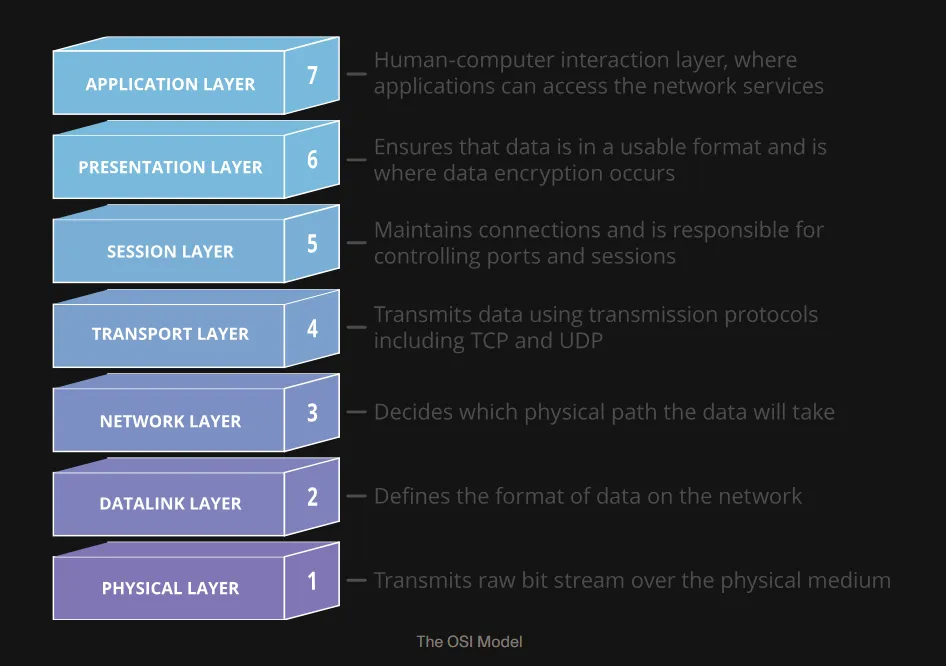
Section titled “What is layer 7 of the Internet?:”Layer 7 refers to the top layer in the 7-layer OSI Model of the Internet. It is also known as the “application layer.” It is the top layer of the data processing that occurs just below the surface or behind the scenes of the software applications that users interact with. The HTTP requests and responses used to load webpages, for example, are layer 7 events
What is the OSI Model?:
Section titled “What is the OSI Model?:”The OSI (open systems interconnection) Model divides the functions of a networking system into 7 layers.
It is worth keeping in mind that the OSI Model is purely theoretical, and it is designed to help describe what takes place in networking communications, not to describe the actual technology involved.
HTTP (HyperText Transfer Protocol)
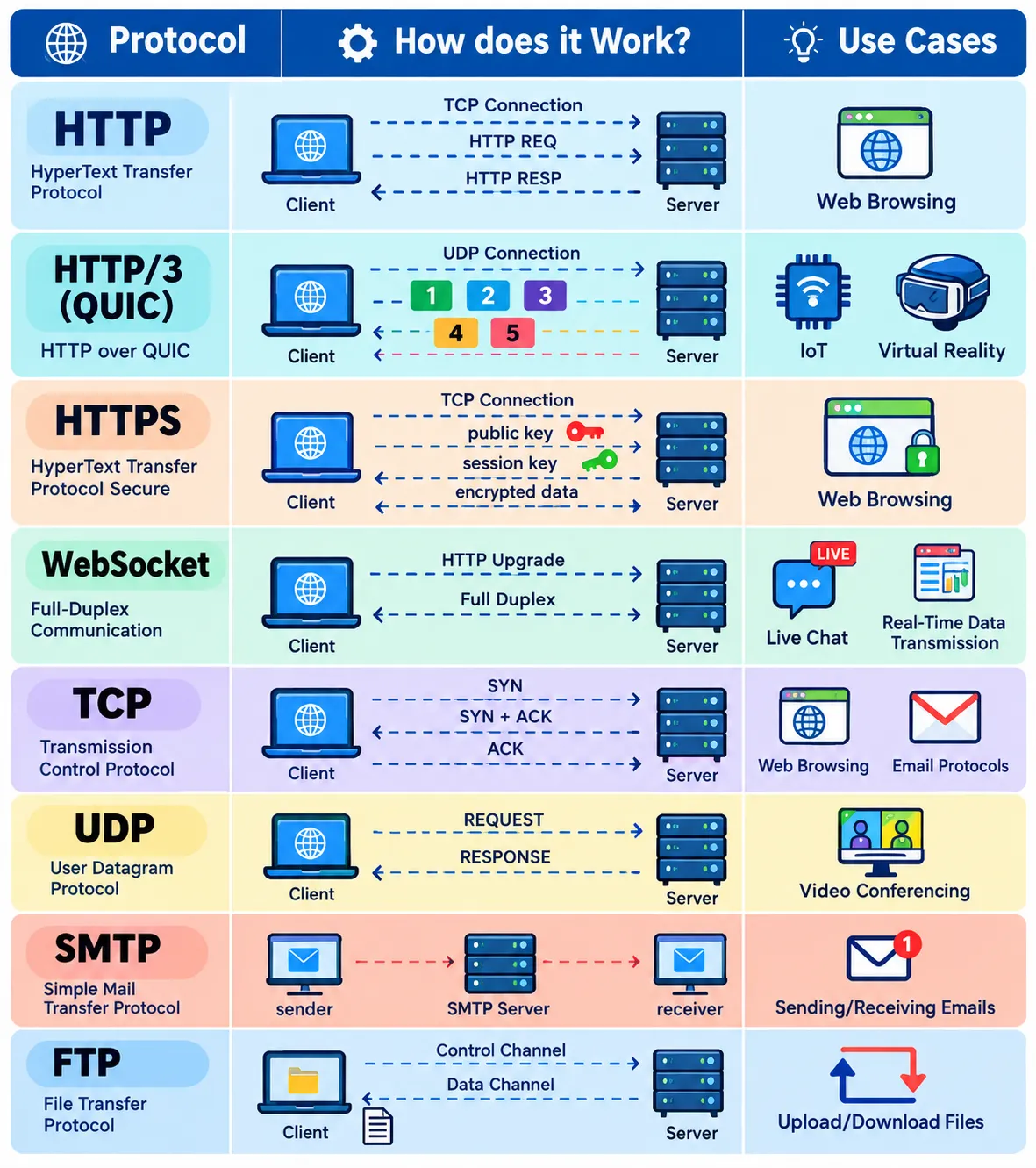
Section titled “HTTP (HyperText Transfer Protocol)”HTTP is a protocol for fetching resources such as HTML documents.
It is way of Internet communications platforms such as web browsers ask for the information they need to load a website.
HTTP/3
Section titled “HTTP/3”HTTP/3 is the next major revision of the HTTP. It runs on QUIC, a new transport protocol designed for mobile-heavy internet usage. It relies on UDP instead of TCP, which enables faster web page responsiveness. VR applications demand more bandwidth to render intricate details of a virtual scene and will likely benefit from migrating to HTTP/3 powered by QUIC.
HTTPS (HyperText Transfer Protocol Secure)
Section titled “HTTPS (HyperText Transfer Protocol Secure)”HTTPS extends HTTP and uses encryption for secure communications.
WebSocket
Section titled “WebSocket”WebSocket is a protocol that provides full-duplex communications over TCP. Clients establish WebSockets to receive real-time updates from the back-end services. Unlike REST, which always “pulls” data, WebSocket enables data to be “pushed”. Applications, like online gaming, stock trading, and messaging apps leverage WebSocket for real-time communication.
TCP (Transmission Control Protocol)
Section titled “TCP (Transmission Control Protocol)”TCP is designed to send packets across the internet and ensure the successful delivery of data and messages over networks. Many application-layer protocols build on top of TCP.
UDP (User Datagram Protocol)
Section titled “UDP (User Datagram Protocol)”UDP sends packets directly to a target computer, without establishing a connection first. UDP is commonly used in time-sensitive communications where occasionally dropping packets is better than waiting. Voice and video traffic are often sent using this protocol.
SMTP (Simple Mail Transfer Protocol)
Section titled “SMTP (Simple Mail Transfer Protocol)”SMTP is a standard protocol to transfer electronic mail from one user to another.
FTP (File Transfer Protocol)
Section titled “FTP (File Transfer Protocol)”FTP is used to transfer computer files between client and server. It has separate connections for the control channel and data channel.